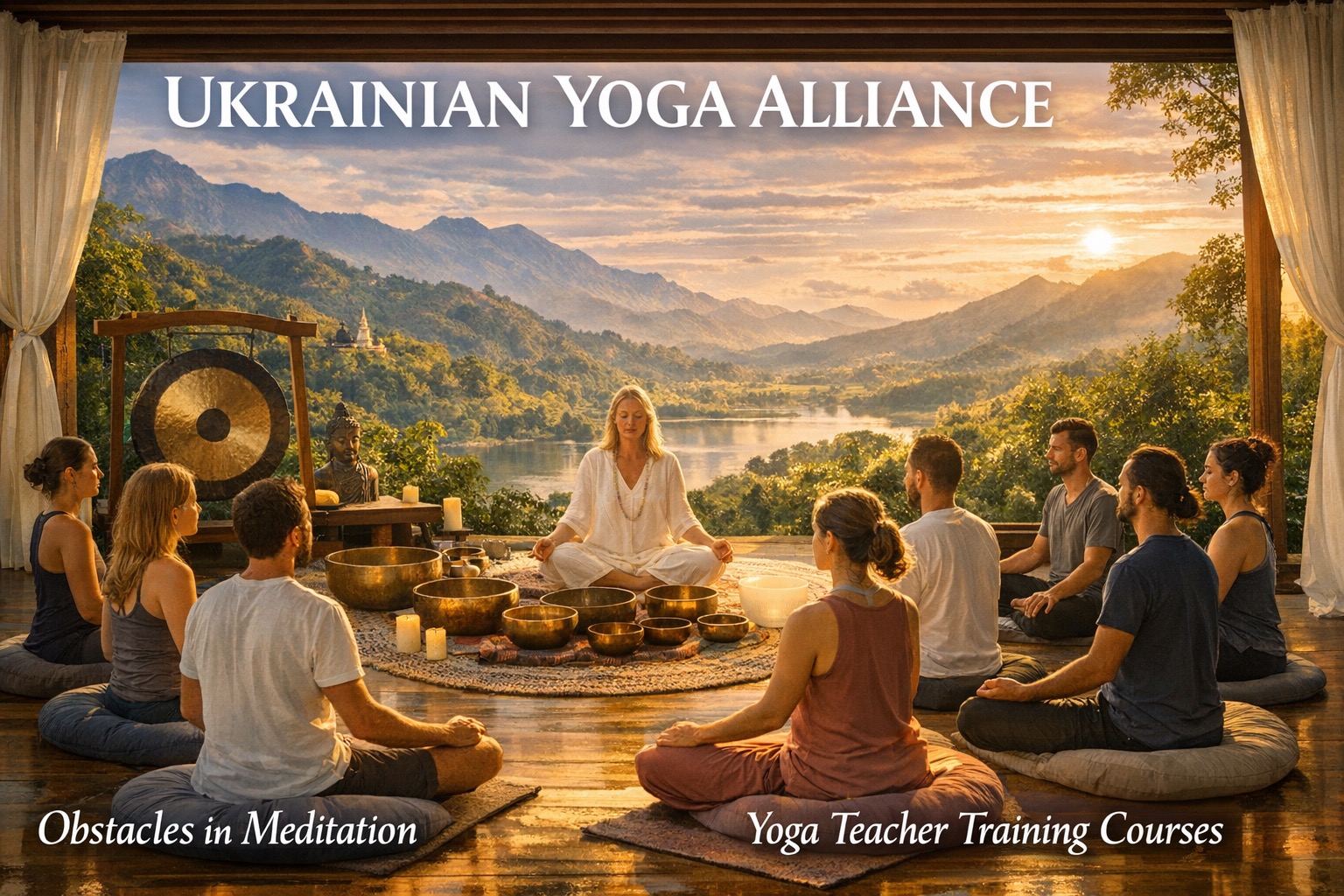
29 Мар Obstacles in meditation and the path to mastery: a course for yoga and mindfulness instructors
OBSTACLES IN MEDITATION AND THE PATH TO MASTERY
Yoga Instructor Training Course at Yoga Alliance
You can read more about the Yoga Instructor Course on the course website:
kurspoyoge.com
Course registration:
📞 Phone: +380984777777
(Viber / Telegram / WhatsApp)
Yoga Alliance website:
yogaalliance.com.ua
Meditation is not just a relaxation technique. It is a fundamental skill of managing attention, state, and consciousness. In the modern world, where a person faces information overload, stress, and constant tension every day, meditation becomes not a luxury but a necessity. However, before learning to guide others and share knowledge, it is essential to go through your own path and deeply understand internal processes. Along this path, everyone encounters natural obstacles, and it is precisely overcoming them that forms the maturity of a practitioner and a future instructor.
At the initial stage of practice, many people face physical discomfort. Pain may arise in the back, neck, and legs, making it difficult to maintain a still posture even for a short period. This is связано not only with physical limitations but also with internal adaptation processes, including changes in habitual tension patterns in the body. For a future instructor, it is important not just to endure discomfort but to understand how to properly build posture, which asanas prepare the body, how spinal alignment works, and how to safely guide students through this stage. It is also important to consider the individual characteristics of each person’s body. Over time, the body adapts, excessive tension disappears, and the practice becomes stable and comfortable.
Another obstacle is external distraction. Sounds, environment, people, and unexpected stimuli can interfere with concentration and cause irritation. This is especially noticeable for those who are привыкли to constant stimulation and are not used to silence. However, this stage develops a key skill — the ability to maintain attention regardless of external conditions. Practice gradually becomes independent of the environment and turns into an internal process. For an instructor, it is important not only to master this personally but also to be able to explain to students how to work with distractions without suppressing them, but by including them in the field of awareness.
One of the main barriers is the wandering mind. Thoughts continuously arise, replace one another, and pull attention into the past or the future. A person can remain in this mental flow for hours without realizing it. It is important to understand that stopping thinking is impossible, and attempts to suppress thoughts only create more tension. The goal of practice is to develop the ability to observe thoughts without becoming involved in them. Observing the breath, bodily sensations, and attention itself helps gradually separate awareness from thinking. Over time, a space appears between thought and reaction, which is one of the key signs of progress in meditation.
At a certain stage, many experience a loss of interest. After the initial inspiration and novelty, practice may seem monotonous, boring, and lacking quick results. This often leads to stopping the practice. However, this is actually a crucial stage where a transition occurs from external motivation to internal discipline. Practice stops depending on emotions and begins to rely on conscious choice. For a future instructor, this stage is critically important, as it allows understanding the nature of students’ motivation and learning how to support them in maintaining regular practice.
Another important stage involves doubts about the practice and one’s own abilities. Questions arise about whether the techniques are performed correctly, whether the method is effective, and whether results are achievable. A person may compare themselves with others, feel uncertainty, and experience internal contradictions. At a deeper level, there may even be a loss of faith in the practice itself. In traditional teachings, this is considered a stage of deep transformation, necessary for moving beyond superficial understanding. A true instructor is not someone who has no doubts, but someone who has gone through them, explored them, and formed their own understanding.
Special attention should be given to doubts about methods. At the beginning, a person may try different techniques, compare approaches, and search for the most effective path. This is a natural and necessary stage. It is important to allow time for exploration, but not to get stuck in constantly changing methods. Depth in practice is achieved through consistency and regularity. A future instructor must not only find a suitable method but also understand its structure, limitations, and potential.
Another important aspect is doubt about the correct execution of techniques. It is impossible to consider all details immediately, so mistakes are a natural part of learning. Feedback from a teacher and the ability to adjust practice are essential. At the same time, extremes should be avoided — excessive perfectionism and, on the other hand, a superficial approach. Balance between precision and natural execution is the foundation of effective practice.
Meditation is the development of stable attention, the ability to manage one’s state, and a deep understanding of one’s own nature. It is not a quick result but a gradual process of transformation. Regular practice reduces stress levels, stabilizes emotional state, improves cognitive functions, enhances concentration, and unlocks inner potential. It also influences decision-making quality, energy levels, and overall perception of life.
Yoga Alliance offers systematic training for those who want not only to master the practice but also to reach a professional level. The program is designed to form a holistic understanding of meditation by combining theoretical knowledge and practical experience. It is suitable for both beginners and practitioners who want to deepen their practice and systematize their knowledge.
The course provides a fundamental understanding of meditation and concentration. It includes a detailed study of asanas for long meditation, including their anatomical and energetic aspects. Participants learn preparatory Hatha yoga sequences aimed at opening the body and releasing tension. Special attention is given to breathing techniques, including pranayama, which help stabilize the mind and prepare it for meditation. Bandhas and mudras are also studied as tools for deepening the practice.
Additionally, participants gain a systematic understanding of various meditation techniques, their purposes, and their applications. All major obstacles encountered in practice are analyzed, along with ways to overcome them. This allows not only understanding one’s own processes but also effectively working with students.
The instructor training program includes teaching methodology, principles of structuring classes, working with groups, and addressing individual differences among students. Psychological aspects of interaction, methods of maintaining group attention, and creating a safe practice space are also covered. Special focus is placed on common beginner mistakes and ways to correct them.
An important part of the training is developing one’s own teaching style. An instructor does not simply transmit techniques but becomes a guide who helps students build their own path. This requires not only knowledge but also personal experience, inner stability, and an understanding of the processes occurring in human consciousness.
The result of the training is the formation of a deep personal practice, a stable internal state, and the ability to manage attention. Participants gain systematic knowledge of how the body and mind function, as well as practical teaching skills. This opens opportunities for professional realization in the field of yoga and meditation, including conducting individual sessions, group classes, and creating personal training programs.
It is important to understand that meditation is a skill that requires a systematic approach, regular practice, and proper guidance. Without structure and understanding, most people either stop practicing or fail to achieve meaningful results. That is why training under the guidance of experienced teachers significantly accelerates progress and makes the process more conscious.
Sirsasana in Yoga Instructor Training
In professional yoga instructor training courses, the headstand is studied not only as a posture but also as an important element of teaching methodology.
Future instructors study:
• anatomy of the spine and neck
• safe techniques for entering the posture
• preparatory exercises
• simplified variations
• wall support and student assistance
• contraindications
Special attention is given to practice safety, since incorrect execution of inversion postures can lead to excessive strain on the cervical spine.
That is why in professional yoga instructor training programs Sirsasana is studied gradually — from preparatory postures to the full headstand.
Yoga Instructor Training Courses
If you want to study yoga more deeply and learn how to teach asanas professionally, you can take an international yoga instructor training course — 200 hours.
The course includes:
• fundamentals of Hatha Yoga
• anatomy and physiology
• asana techniques
• pranayama and breathing practices
• meditation
• yoga teaching methodology
• safe class sequencing
• yoga philosophy
After completing the training, you receive an international yoga instructor certificate, which allows you to teach yoga in different countries around the world.
Teacher Training and Certification
The Ukrainian Yoga Alliance is the largest non-profit organization responsible for establishing and maintaining yoga teaching standards in Ukraine.
The main areas of activity of the Alliance include:
•uniting the professional yoga community;
•developing and approving qualification requirements;
•official certification of yoga instructors;
•maintaining the Unified Register of Certified Teachers.
The Ukrainian Yoga Alliance is the largest non-profit organization that establishes and maintains yoga teaching standards in Ukraine.
The main areas of activity of the Alliance include:
•uniting the professional yoga community,
•developing and approving qualification requirements,
•official certification of yoga instructors,
•maintaining the Unified Register of Certified Yoga Teachers.
Training Format and Examination
Within online yoga instructor training courses, students of the Yoga Alliance School undergo mandatory practical and theoretical assessment.
Passing Surya Namaskar is part of the examination process.
A video of the exam, conducted within online courses, is available via the link — click to watch.
You can watch a full video overview of the online course by the Head of the Yoga Alliance, Vladimir Bondarenko, on our YouTube channel by following the link.
Training Locations and Tuition Fees
Branches of the Yoga Alliance School have resumed operations in the following cities:
• Kyiv
• Kharkiv
• Dnipro
• Odesa
• Lviv
• Klaipėda (Lithuania)
• Bansko (Bulgaria)
• Athens (Greece)
• Prague (Czech Republic)
• Torrevieja (Spain)
• Vienna (Austria)
• Cascais (Portugal)
These branches offer continuously running offline yoga instructor training courses led by senior instructors of the Alliance.
Tuition fees:
•online course — 15,500 UAH
•offline course — 17,500 UAH
Since August 2022, instructors who successfully pass examinations with distinction receive the right to train future yoga instructors on behalf of the Yoga Alliance and conduct teacher training courses jointly with the Organization.
Such instructors receive the status of Senior Instructor of the Yoga Alliance and earn 50% of the course fee for each student.
For full details, contact us via Viber / Telegram / WhatsApp:
+380984777777
Training Results
After completing the one-month course and successfully passing the exams, you will:
•receive two international Yoga Alliance certificates registered with the Ministry of Justice of Ukraine;
•obtain the right to teach yoga in more than 100 countries worldwide;
•master a well-structured class format including kriyas, pranayama, and meditation;
•receive lifetime access to video lessons, an application for learning posture names, and 12 balanced printed lesson plans for the first year of teaching;
•receive the “Gold Standard” methodological guide — a detailed manual on asanas, chakras, mudras, bandhas, and key techniques of classical yoga.
Additional Materials
Contacts and Registration
You can read more about the Yoga Instructor Course on the course website:
Course registration:
📞 Phone: +380984777777
(Viber / Telegram / WhatsApp)
Yoga Alliance website: