29 Сен Yoga Instructor Training from Beginner Level — 200-Hour Yoga Alliance Teacher Training Course, International Certification and Online Study
Yoga Teacher Training — International Yoga Instructor Course by Yoga Alliance Ukraine
You can read more about the Yoga Instructor Course on the course website:
kurspoyoge.com
Course registration:
📞 Phone: +380984777777
(Viber / Telegram / WhatsApp)
Yoga Alliance website:
yogaalliance.com.ua
For many people, the decision to become a yoga instructor begins with a simple question: where should you complete your training?
Today, future yoga teachers have a huge number of options: training in India, international yoga schools, intensive two-week programs, month-long courses, online training, individual instruction, and teacher training programs in Ukraine and other European countries.
At first glance, it may seem that all you need to do is choose a good school, complete a course, receive a certificate, and start teaching. However, becoming a professional yoga instructor requires much more.
A certificate alone does not make someone a teacher.
The real purpose of a high-quality yoga teacher training course is not simply to introduce students to a collection of asanas, pranayama techniques, and meditation practices. Its purpose is to develop a professional who understands the practice, can explain it clearly to another person, recognizes students’ mistakes, knows how to correct technique, understands contraindications, can independently structure a complete class, and recognizes the responsibility a teacher has toward their students.
Therefore, you should not choose a training program based solely on the country or an attractive certificate. First and foremost, you should choose a system of education.
Let us examine in detail what a future yoga instructor should really consider when choosing a teacher training program.
Yoga Training in India: Atmosphere, Tradition, and the Reality of Teacher Training Courses
Let us begin with India.
Rishikesh is rightly considered one of the world’s best-known centers of yoga. It is home to a large number of ashrams, schools, and educational centers offering both foundational and advanced yoga teacher training programs.
For anyone interested in yoga, traveling to India can itself be an extraordinary experience.
It is an entirely different cultural environment.
The streets of Rishikesh, the Ganges, ashrams, traditional ceremonies, Indian temples, incense, mantras, local cuisine, and the many yoga schools and teachers create an atmosphere that is genuinely difficult to reproduce in Europe.
For this reason, traveling to India can have tremendous emotional and cultural value.
However, it is important to distinguish between two very different goals: traveling to India to immerse yourself in the culture and atmosphere of yoga, and obtaining professional training sufficient for independent teaching.
These are not always the same thing.
How Much Does Yoga Teacher Training in India Cost?
The total cost of the trip depends on the particular school, the season, the duration of the course, the standard of accommodation, and airfare.
If a future student wants to stay not in extremely basic conditions but in a comfortable room with a private bathroom, air conditioning, and reasonable living conditions, it is important to consider not only the cost of the course itself but also flights, transfers, accommodation, food, insurance, and additional expenses.
As a result, a complete training trip may cost several thousand US dollars.
What do you receive for this money?
First and foremost, a unique experience.
You find yourself in a country where yoga is deeply connected with cultural tradition. You encounter an entirely different way of life, meet teachers and practitioners from different countries, visit sacred places, observe Indian ceremonies, and completely change your usual environment for a period of time.
For many people, this truly becomes an unforgettable journey.
But if your main objective is to become a yoga teacher, you need to evaluate more than the atmosphere.
You should ask yourself a much more practical question:
After completing the course, will you be able to independently conduct a safe, structured, and professional two-hour yoga class for a group of students?
The answer to this question is one of the most important indicators of the quality of a yoga teacher training program.
Why an Intensive Course May Not Be Enough
Yoga is an enormous system of knowledge.
It is not limited to physical exercise.
A future yoga instructor needs to study the philosophical foundations of yoga, asana technique, basic anatomy and physiology, breathing practices, principles of sequencing, meditation, concentration techniques, kriyas, bandhas, mudras, safety principles, contraindications, and, most importantly, teaching methodology.
The problem with many intensive programs is not necessarily that their teachers lack qualifications.
The problem is the amount of information that students are expected to absorb within a very short period of time.
Even if a person is shown dozens of asanas, pranayama techniques, and other practices over two or three weeks, this does not automatically mean that they have learned how to teach them.
There is a fundamental difference between:
“I have seen how this is done”;
“I can perform this myself”;
and
“I can safely and clearly teach another person how to do it.”
The third objective is the fundamental purpose of professional yoga teacher training.
The Language Barrier When Training Abroad
The language of instruction deserves special consideration.
In a basic yoga class, it may be enough to understand simple instructions such as “inhale,” “exhale,” “raise your right arm,” “place your left foot,” or “bend forward.”
Professional education, however, requires a completely different level of communication.
Imagine a teacher explaining why a particular pelvic position creates additional stress on the lumbar spine; how body weight should be distributed; how to modify a posture for a student with limited mobility; what contraindications exist; how one breathing technique differs from another; how to recognize an error; how to adapt a practice; how to work with attention; or how to explain philosophical concepts.
Basic conversational English may no longer be sufficient.
For this reason, studying in a language that the student understands thoroughly offers a major advantage.
Students should be able to ask any question, receive a detailed answer, clarify anything they do not understand, and review a difficult technique several times if necessary.
Why Teaching Materials Are So Important
One of the most important criteria of a professional yoga teacher training course is the availability of comprehensive teaching materials.
Not a few pages.
Not a short presentation.
Not simply a list of asanas.
A future yoga teacher needs genuine educational material that they can continue to use after completing the course.
It is impossible to hear an enormous amount of information once and remember everything.
A high-quality teacher training course should therefore provide not only knowledge during the classes themselves, but also a professional resource for continued development.
How Much Knowledge Does a Future Yoga Teacher Need to Master?
To understand the scale of professional preparation, it is enough to look at some of the major areas that may be included in a comprehensive training program.
The Eight Limbs of Ashtanga Yoga
In the classical tradition associated with Patanjali’s Yoga Sutras, the eight limbs include:
Yama:
Ahimsa — non-violence;
Satya — truthfulness;
Asteya — non-stealing;
Brahmacharya — traditionally associated with the conscious management of energy and desire;
Aparigraha — non-possessiveness and non-attachment.
Niyama:
Saucha — purity;
Santosha — contentment;
Tapas — discipline;
Svadhyaya — self-study and study of traditional texts;
Ishvara Pranidhana — dedication or surrender to a higher principle.
These are followed by:
Asana;
Pranayama;
Pratyahara;
Dharana;
Dhyana;
Samadhi.
A future teacher should understand the place of these elements within the broader system of yoga and be able to explain to students why yoga extends far beyond physical exercise.
The Seven Stages Described in the Gheranda Samhita
In the study of traditional Hatha Yoga, students may examine:
Shatkarma — purification practices;
Asana — posture;
Mudra — specialized gestures and techniques;
Pratyahara — withdrawal of the senses from external objects;
Pranayama — breathing practices and the traditional concept of working with prana;
Dhyana — meditation;
Samadhi — the traditional state of deep meditative absorption.
Chakras
Within the traditional yogic model, the principal energy centers studied include:
Muladhara;
Svadhisthana;
Manipura;
Anahata;
Vishuddha;
Ajna;
Sahasrara.
In professional teaching, it is important to distinguish traditional philosophical models of yoga from contemporary medical knowledge.
This allows a teacher to respect and preserve the tradition without presenting philosophical or energetic concepts as established medical facts.
Shatkarmas and Cleansing Practices
The curriculum may include:
Jala Neti;
Basti;
Agnisara;
Nauli;
Trataka;
Kapalabhati and other traditional practices.
When studying these techniques, particular attention must be paid to safety, contraindications, and understanding which practices require preliminary preparation.
A teacher should know not merely the name of a technique but when, how, and for whom it may be appropriate.
Bandhas
The curriculum may include:
Uddiyana Bandha;
Mula Bandha;
Maha Bandha and other combinations.
It is important to understand correct technique, the appropriate progression for learning, and relevant limitations.
Nadis
Within the traditional yogic model, students may study:
Ida;
Pingala;
Sushumna.
Pranayama
Future yoga teachers may study a range of breathing techniques, including:
Kapalabhati;
Anuloma Viloma;
Nadi Shodhana;
Ujjayi;
Bhastrika;
Murchha and other practices.
Knowing only the sequence of inhalations and exhalations is not enough.
A teacher needs to understand pace, duration, body position, preparatory exercises, possible limitations, and the correct progression for learning each technique.
Mudras
A training program may include:
Chin Mudra;
Jnana Mudra;
Manduki Mudra;
Maha Mudra;
Tadagi Mudra;
Viparita Karani Mudra;
Shambhavi Mudra;
Nasikagra Mudra and others.
Meditation and Concentration
Meditative practice is another major area of study.
A future instructor should understand the distinction between relaxation, concentration, and meditation, know different methods of preparing attention, understand common difficulties experienced by beginners, and be able to guide students appropriately through a practice.
This may include:
preliminary concentration;
stability of attention;
observation;
working with an object of concentration;
reflection;
contemplation;
various meditation techniques.
And this is only part of the curriculum.
For this reason, promises to transform someone into a fully prepared professional yoga teacher in only a few days should be evaluated carefully.
The Purpose of Training Is to Provide a System, Not Simply Information
A good teacher training program should be structured so that students are not overwhelmed by the volume of new information.
First, they receive a framework.
Then they study the individual components.
After that, they learn how those components fit together.
Only then do they begin teaching independently.
This is why ready-made, methodically structured lessons can be extremely valuable.
Students need to understand not only individual exercises, but also how a complete yoga class is created from them.
Why is one technique performed before another?
How should a class begin?
When should breathing exercises be introduced?
How should joint warm-up exercises be structured?
In what order should asanas be taught?
When should compensatory postures be used?
How should a practice be concluded?
How much time should be reserved for Shavasana?
Which techniques should not be combined without appropriate preparation?
How can the same lesson be adapted for a beginner and a more experienced student?
The answers to questions like these gradually develop a student into a teacher.
What a Structured Yoga Lesson May Look Like
Let us consider a shortened example of a training class.
Lesson One. First Monday
Students begin in Siddhasana, Siddha Yoni Asana, or, when necessary, the more accessible Sukhasana.
It is important to teach future instructors from the beginning to offer alternative positions because a group almost never consists of people with identical mobility and physical preparation.
1. AUM
The hands are placed in Namaskara Mudra in front of the chest.
The practice is performed three times.
The main purpose at the beginning of the practice is to shift attention away from everyday activity, calm the breath, and establish a state of concentration.
2. Basti Kriya / Pelvic Floor Practice
Within the training sequence, controlled work with the pelvic floor muscles and the principles of Mula Bandha are introduced.
During training, limitations and situations in which a particular practice should be excluded or adapted must be discussed.
3. Agnisara Kriya
Students learn controlled movement of the abdominal wall after exhalation and during a comfortable breath retention.
The number of repetitions is increased gradually.
Particular attention is given to contraindications.
4. Nauli Kriya
Nauli is a more advanced traditional practice and requires prior development of basic abdominal control.
For a future teacher, it is particularly important to understand that demonstrating an advanced technique does not mean that every student should immediately be asked to perform it.
5. Anuloma Viloma
This is one of the best-known alternate-nostril breathing practices.
A future instructor learns to observe not only the breathing sequence but also spinal position, unnecessary tension in the face and shoulders, and the student’s overall condition.
6. Trataka
External and internal concentration practices are studied.
Limitations and the need to stop the practice in the event of significant discomfort are discussed separately.
7. Joint Warm-Up
The major joints and muscle groups are prepared progressively.
8. Final Stage of Joint Preparation
Movements are performed to prepare the body specifically for the main asana sequence.
9. Surya Namaskar
Students learn the sequence of Sun Salutation.
Simplified variations are introduced when necessary. After several rounds, a restorative position such as Balasana may be used.
10. Seated Triangle
The practice is intended to develop hip mobility and work with forward and lateral movement.
Particular attention is given to the condition of the knees, hips, and lower back.
11. Virabhadrasana I
This practice develops leg strength, stability, and control of the pelvis and torso.
Particular attention is paid to the position of the feet, knees, pelvis, spine, and shoulders.
12. Utthita Trikonasana
The asana develops mobility in the legs and hips and requires coordinated positioning of the pelvis, spine, and rib cage.
13. Parsva Purvottanasana
This practice requires good control of the shoulder girdle, wrists, torso, and legs.
The primary principle is that the quality of the position is more important than the depth or complexity of the asana.
14. Garudasana
This asana develops balance, concentration, and coordination.
Accessible modifications should be provided when necessary.
15. Dolphin Pose
This practice can be used to develop the shoulder girdle and prepare the body for more advanced inverted positions.
16. Shirshasana
Headstand is an advanced inversion and should not be regarded as a mandatory exercise for every student.
Appropriate preparation is necessary before attempting it.
A professional yoga teacher should understand an important principle:
the purpose of yoga is not to achieve the most difficult physical form at any cost. Student safety always takes priority.
17. Shavasana
The final relaxation practice.
The instructor learns how to provide appropriate verbal guidance without overwhelming students with information and how to create conditions for complete relaxation.
This is only one example of a training class.
A professional teacher training program should provide future instructors with many similar tools and teach them how to create new sequences independently.
Future Teachers Must Teach During Their Training
This is one of the most important criteria when selecting a course.
You can read dozens of books.
You can watch hundreds of videos.
You can perform asanas beautifully yourself.
But teaching is a separate skill.
For this reason, within the Ukrainian Yoga Alliance training system, students gradually begin teaching while they are still completing their education.
At the end of the first week, a student may be asked to independently demonstrate and explain Surya Namaskar.
During the second week, the student may lead a joint warm-up.
Later, the student demonstrates and explains kriyas, bandhas, pranayama techniques, and asanas.
At the next stage, students learn to combine individual components into a coherent practice.
By the end of the program, they conduct complete classes for students.
The course teacher evaluates whether the trainee:
can speak confidently in front of a group;
gives clear instructions;
recognizes mistakes;
knows how to correct students;
manages time appropriately;
remembers the sequence;
maintains safety;
can explain, demonstrate, and observe the group simultaneously;
can adapt the class to real people with different abilities.
This is what professional teacher preparation means.
The Ability to Correct a Student
One skill that beginner instructors often underestimate is correction.
A student may believe they are performing an asana correctly because their position looks similar to a photograph.
A teacher, however, must see the details.
Consider the relatively simple Marjaryasana, or Cat Pose.
It is not enough to say:
“Inhale and arch your back; exhale and round your spine.”
The teacher should observe spinal movement, the position of the pelvis, shoulder girdle, neck, and head, the quality of breathing, and how movement is distributed through the spine.
The same principle applies to virtually every asana.
This is why a high-quality teacher training course is not simply a course where you are shown many exercises.
It is a course where you are taught how to see the person in front of you.
Teaching Methodology Is More Important Than the Number of Asanas
Some schools advertise their programs by emphasizing the number of asanas students will learn.
However, the number of postures alone says very little about the professional competence of a teacher.
A person may know the names of two hundred asanas and still be unable to structure a safe class.
Conversely, a skilled instructor can create dozens of different practices using a relatively limited set of techniques that they understand thoroughly.
Therefore, when choosing a school, you should ask:
Will you learn how to build sequences?
Will you teach during the course?
Will the teacher correct your individual mistakes?
Will you receive comprehensive educational materials?
Will contraindications and safety be covered?
Will you take a practical examination?
Will you leave the course with a system of classes that you can actually use?
Yoga Instructor Certification
Another important consideration is the document received by the graduate.
An attractive certificate can be printed almost anywhere.
Therefore, you should evaluate more than the appearance of the document.
It is important to understand:
Who issues it?
Does the organization legally exist?
Does it have an official registered name?
Can the organization be verified?
Does it have an official website?
Can a particular graduate’s training be verified?
Is there a registry of certified instructors?
Are the curriculum and duration of training specified?
Can an employer or potential client clearly identify the organization that issued the certificate?
These questions become especially important for people planning to work not only in their own country but also internationally.
Requirements for yoga instructors vary depending on the country and employer. A certificate from a professional or public organization does not in itself replace a government license or regulated qualification where local legislation requires one.
Registry of Certified Yoga Instructors
A publicly accessible registry of certified teachers can be an extremely useful professional tool.
An employer or potential client can visit the organization’s official website, find the teacher, and verify that they have completed the relevant training.
Digital verification of professional qualifications is becoming increasingly important for modern professionals.
For this reason, the Ukrainian Yoga Alliance focuses not only on issuing certificates but also on the professional representation of its graduates.
What Happens After You Receive Your Certificate?
There is another important question that future students often forget to ask:
What does the school do for its graduates after the course is completed?
In one scenario, a person finishes the training, receives a certificate, and the relationship with the school ends.
In another, the graduate becomes part of a professional community.
Their qualification can be verified.
They have opportunities for continued professional development.
They have an organization they can approach with professional questions.
Additional educational programs are available.
There are opportunities to participate in events and to develop a professional presence as a teacher.
For someone who wants to turn an interest in yoga into a profession, this approach can offer significantly greater practical value.
American Yoga Alliance and the Ukrainian Yoga Alliance
There are various professional and public organizations working in the field of yoga around the world.
One of the best known is the US-based Yoga Alliance.
However, it is important to understand a fundamental point:
registration with a professional organization and high-quality yoga teacher education are not the same thing.
The name of an organization should never replace a careful evaluation of the actual training program.
You should consider:
where you intend to work;
what documentation a particular employer requires;
which training program you completed;
how many hours the program includes;
whether practical teaching experience is included;
whether your qualification can be verified;
what support the organization provides after certification.
The Ukrainian Yoga Alliance is primarily focused on the needs of yoga teachers and yoga schools in Ukraine and the Ukrainian community, including professionals working in Europe and other countries.
One advantage of a professional organization is its understanding of the actual environment in which its teachers work: the language, audience, market, opportunities for professional development, and interaction with other specialists.
Not a Certificate for the Sake of a Certificate, but Real Professional Value
If a person invests money and time in education, they should understand exactly what they will receive.
Only a document — or a profession?
Only an impressive name — or genuine knowledge?
Only several weeks of classes — or a system they can use for years?
Only a certificate — or the ability to verify their qualification?
Only training — or a professional community after graduation?
The answers to these questions are far more important than how impressive a school’s name may sound.
How to Choose a Truly High-Quality Yoga Instructor Course
Before paying for a course, ask to see the curriculum.
Confirm the total number of training hours.
Find out who will teach you.
Ask whether you will receive comprehensive teaching materials.
Confirm whether supervised teaching practice is included.
Ask how many complete classes you will personally teach before receiving your certificate.
Find out whether safety and contraindications are covered.
Ask how the examination process works.
Request an example of the certificate.
Find out which organization issues the document.
Check whether the organization has an official website and a graduate registry.
Ask what support is available after graduation.
Only after answering these questions should you compare prices.
The cheapest course may ultimately become expensive if you later discover that you need to complete your training again.
And the most expensive program is not necessarily the highest-quality program.
An Individual Approach
Students enter yoga teacher training with very different levels of experience.
One student may have practiced yoga for ten years.
Another for two years.
A third may be physically well prepared but know almost nothing about pranayama.
A fourth may understand yoga philosophy very well but struggle with certain asanas.
A fifth may understand technique but feel uncomfortable speaking in front of a group.
For this reason, it is difficult to prepare professional teachers effectively through a purely standardized, assembly-line approach.
A good teacher should recognize the strengths and weaknesses of each individual student.
One student may need more attention to technique.
Another may need help with voice and verbal instructions.
Another may need to work on sequencing.
Another may need to develop confidence when working with groups.
Individual correction is what transforms a general course into genuine professional preparation.
Yoga Is Not Simply Fitness — and It Is Not Religious Preaching
A professional teacher should understand the boundaries of their competence.
Yoga has an ancient philosophical tradition while also being widely practiced by modern people as a physical and psycho-emotional discipline.
A teacher should avoid reducing yoga exclusively to fitness while also avoiding imposing religious beliefs on students.
The instructor’s role is to provide a practice.
Explain its origins.
Discuss its tradition.
Teach the technique.
Create conditions for a safe personal experience.
Respect the worldview of every student.
This approach makes it possible to preserve the depth of yoga while making it accessible to modern practitioners.
Safety Is a Sign of Professionalism
A professional yoga teacher should not be judged by how many difficult asanas they can perform.
It is far more important to understand how well they recognize limitations.
A professional instructor can tell a student:
“This practice is not appropriate for you today.”
They can offer an alternative.
They do not force a person to tolerate pain for the sake of an attractive posture.
They do not attempt to push every student into the splits at any cost.
They do not place a student in an advanced inversion simply because it looks impressive in a photograph.
They do not claim to treat medical conditions unless they possess the appropriate medical qualifications.
They understand the boundaries of their professional competence.
This is one of the most important characteristics of a mature teacher.
How Long Does It Take to Become a Yoga Teacher?
There is no universal period after which every person automatically becomes a good yoga teacher.
Some people enter teacher training after many years of personal practice.
Others begin with much less experience.
However, one important principle remains:
the more extensive the curriculum, the more time is required not only to study the material but also to develop practical competence.
For this reason, promises to turn someone into a professional teacher within only a few days should be approached cautiously.
A course may provide an intensive beginning.
Professional development, however, continues long after the course is completed.
A good school should not create the illusion that education ends when the certificate is awarded. Instead, it should give graduates a strong foundation for continued development.
The Most Important Outcome of a Yoga Instructor Training Course
Imagine the final day of your training.
A group of students is standing in front of you.
You must independently conduct a complete class.
Without the teacher prompting you.
Without watching a video.
Without reading every next instruction from your phone.
You need to understand why each technique is being performed.
You need to see the people in front of you.
Correct mistakes.
Offer simplified alternatives.
Manage the time.
Remember contraindications.
Control the pace of the class.
Explain breathing correctly.
Create a logical sequence.
Recognize when a student needs rest.
Confidently conclude the practice.
And afterwards, you should be able to explain to your teacher why you structured the class in exactly that way.
That is one of the most important outcomes of high-quality yoga teacher training.
Not a photograph holding a certificate.
Not the number of Sanskrit terms you have memorized.
Not the ability to perform an impressive asana.
But the ability to professionally teach other people.
What the Ukrainian Yoga Alliance Training System Offers
The Ukrainian Yoga Alliance approach is based on comprehensive teacher preparation.
Students should receive not fragmented pieces of information, but a complete system.
The training process therefore places particular importance on:
a comprehensive training curriculum;
structured teaching materials;
step-by-step study of techniques;
traditional foundations of yoga;
asanas;
pranayama;
meditation practices;
bandhas;
mudras;
shatkarmas;
safety principles;
contraindications;
class sequencing methodology;
ready-made examples of class sequences;
teaching practice;
correction of mistakes;
assessment of knowledge;
a practical examination;
certification;
the ability to verify qualifications;
continued professional development.
The central idea is that after completing the program, graduates should not be asking themselves:
“What am I supposed to do with this certificate now?”
They should understand how to conduct their first class.
How to structure their second.
How to create a program for a week or a month.
How to work with a regular group.
How to explain techniques to students.
How to continue their own education.
How to develop professionally as an instructor.
Training as an Investment in a New Profession
Many people enroll in yoga teacher training primarily for their own development.
That is also an excellent reason to study.
A deeper understanding of yoga can significantly change the quality of a person’s own practice.
For other students, however, training becomes the beginning of a new professional career.
A qualified instructor may:
conduct private yoga sessions;
create their own yoga group;
work in a yoga studio;
cooperate with fitness and wellness centers;
teach online yoga classes;
develop original programs;
organize workshops;
conduct retreats;
continue specializing in particular areas of yoga.
For this reason, the cost of high-quality education should not be viewed only as the price of a course.
It is an investment in knowledge, professional qualifications, and a potential career.
The stronger the foundation, the more confidently a teacher can continue to develop.
India or a Professional Yoga Alliance Course?
If your dream is to see Rishikesh, visit the banks of the Ganges, experience Indian culture, stay in an ashram, and immerse yourself in the atmosphere of the country where many yoga traditions developed, traveling to India can be a wonderful experience.
Nothing can fully replace that experience.
But if your primary goal is to obtain professional preparation, you should first evaluate the quality of the specific educational program.
The country itself is not a guarantee of quality.
The curriculum matters.
The teacher matters.
The methodology matters.
The amount of practical experience matters.
Feedback matters.
The quality of educational materials matters.
What ultimately matters is the kind of professional you become after completing the course.
For many people, an ideal approach may be to combine both opportunities:
first obtain structured professional education in a language you understand thoroughly, and then travel to India as a prepared practitioner — for culture, tradition, additional experience, and inspiration.
India can then be experienced very differently.
You already understand the terminology.
You know the fundamental techniques.
You are able to compare schools and teaching approaches.
You can understand instructors at a much deeper level.
You are better equipped to distinguish serious teaching from attractive presentation.
The journey becomes not a substitute for professional education, but a continuation of it.
What Should a Modern Yoga Instructor Be Like?
A modern yoga teacher is not simply someone who stands in front of a group and demonstrates asanas.
A professional teacher is someone who continues to develop.
They study tradition while also becoming familiar with contemporary knowledge of anatomy and physiology.
They can distinguish philosophical concepts from medical claims.
They understand the individual characteristics of their students.
They know the boundaries of their professional competence.
They can work with beginners.
They know how to adapt practices.
They continue their own education.
They do not stop being a student when they become a teacher.
This is the kind of professional most people want in front of them when they attend a yoga class.
And this is the kind of teacher that a professional training school should strive to prepare.
How to Make Your Final Decision
Do not choose a yoga teacher training course solely because of attractive advertising.
Do not choose solely because of the country.
Do not choose solely based on price.
Do not choose solely because of an impressive international name.
Do not choose simply because the certificate looks attractive.
Study the curriculum.
Review the educational materials.
Learn about the teachers.
Find out how much time you will spend practicing.
Ask how much time you will spend teaching independently.
Verify the organization that issues the certificate.
Find out whether your qualification can still be verified several years later.
Ask what happens to graduates after they complete the program.
And ask the school the most important question:
“What exactly will I be able to do after completing your training?”
The answer to this question will tell you far more about the quality of the course than any advertisement.
Ukrainian Yoga Alliance: 200-Hour Yoga Instructor Training Course
The goal of the Ukrainian Yoga Alliance teacher training course is not simply to hand a student a certificate.
The goal is to prepare a person for real teaching.
For this reason, the training is built around three fundamental components:
knowledge — practice — teaching.
First, students acquire knowledge.
Then they learn to apply that knowledge in their own practice.
After that, they learn how to transfer this knowledge to other people.
Because a real yoga instructor is not the person who knows the greatest number of asana names.
A real instructor is someone who can take a complex system of knowledge and make it understandable, structured, safe, and useful for their students.
If you want to study yoga more deeply, a teacher training course can completely transform your understanding of the practice.
If you want to become an instructor, the course should provide you with a professional foundation.
If you already teach yoga, systematic education can help you organize and deepen the knowledge you have accumulated.
And if you want to make yoga part of your professional life, it is important to begin with high-quality education.
Because ultimately, students do not come to a certificate.
They come to a teacher.
To a person they trust with their body, their time, and their practice.
That is why professional yoga instructor training is not a formality.
It is responsibility.
It is knowledge.
It is practice.
It is the ability to teach.
And it is the foundation on which a future professional career is built.
The Ukrainian Yoga Alliance is not simply about receiving a yoga instructor certificate. It is a system of professional teacher preparation: 200 hours of training, the study of techniques and comprehensive educational materials, practical experience conducting classes independently, certification, and continued professional development.
If your goal is not simply to complete a course but to genuinely learn how to teach yoga, choose an education that prepares you to meet your first students with confidence, professionalism, knowledge, and responsibility.
Teacher Training and Certification
The Ukrainian Yoga Alliance is the largest non-profit organization responsible for establishing and maintaining yoga teaching standards in Ukraine.
The main areas of activity of the Alliance include:
•uniting the professional yoga community;
•developing and approving qualification requirements;
•official certification of yoga instructors;
•maintaining the Unified Register of Certified Teachers.
The Ukrainian Yoga Alliance is the largest non-profit organization that establishes and maintains yoga teaching standards in Ukraine.
The main areas of activity of the Alliance include:
•uniting the professional yoga community,
•developing and approving qualification requirements,
•official certification of yoga instructors,
•maintaining the Unified Register of Certified Yoga Teachers.
Training Format and Examination
Within online yoga instructor training courses, students of the Yoga Alliance School undergo mandatory practical and theoretical assessment.
Passing Surya Namaskar is part of the examination process.
A video of the exam, conducted within online courses, is available via the link — click to watch.
You can watch a full video overview of the online course by the Head of the Yoga Alliance, Vladimir Bondarenko, on our YouTube channel by following the link.
Training Locations and Tuition Fees
Branches of the Yoga Alliance School have resumed operations in the following cities:
• Kyiv
• Kharkiv
• Dnipro
• Odesa
• Lviv
• Klaipėda (Lithuania)
• Bansko (Bulgaria)
• Athens (Greece)
• Prague (Czech Republic)
• Torrevieja (Spain)
• Vienna (Austria)
• Cascais (Portugal)
These branches offer continuously running offline yoga instructor training courses led by senior instructors of the Alliance.
Tuition fees:
•online course — 15,500 UAH
•offline course — 17,500 UAH
Since August 2022, instructors who successfully pass examinations with distinction receive the right to train future yoga instructors on behalf of the Yoga Alliance and conduct teacher training courses jointly with the Organization.
Such instructors receive the status of Senior Instructor of the Yoga Alliance and earn 50% of the course fee for each student.
For full details, contact us via Viber / Telegram / WhatsApp:
+380984777777
Training Results
After completing the one-month course and successfully passing the exams, you will:
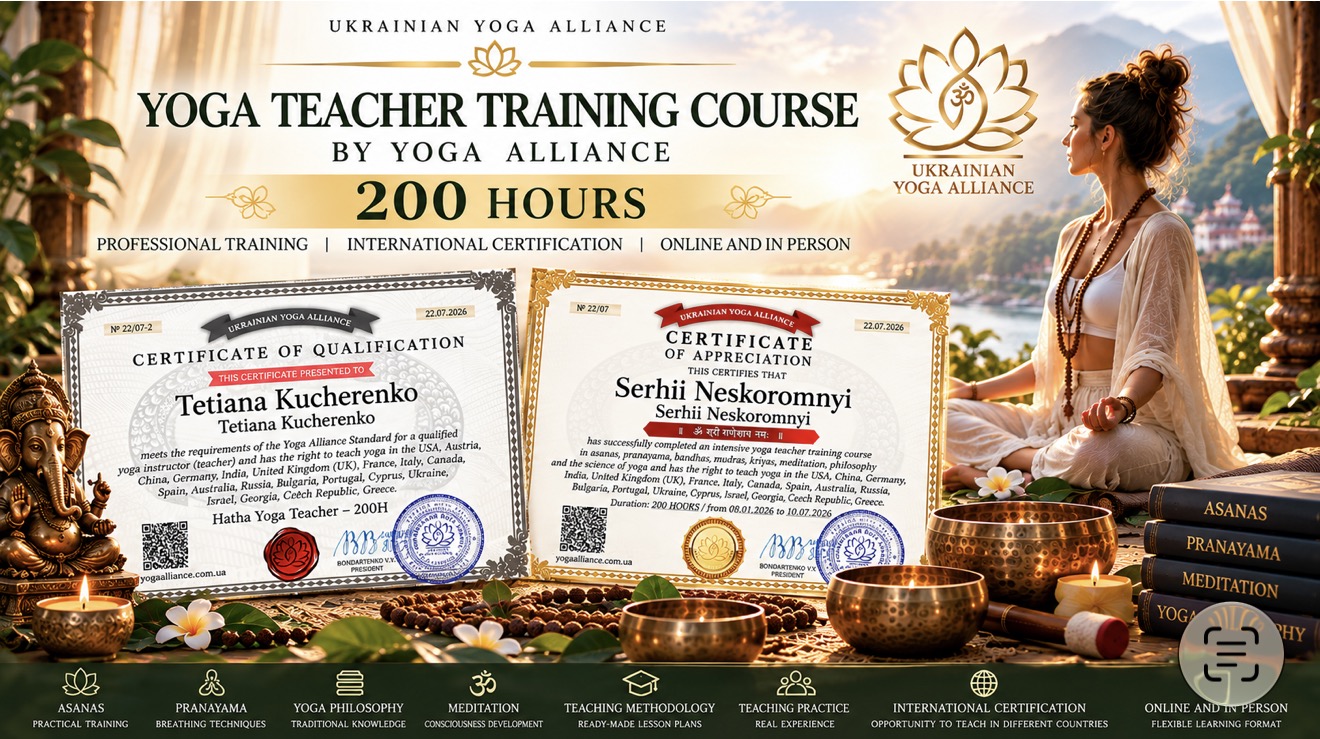
•receive two international Yoga Alliance certificates registered with the Ministry of Justice of Ukraine;
•obtain the right to teach yoga in more than 100 countries worldwide;
•master a well-structured class format including kriyas, pranayama, and meditation;
•receive lifetime access to video lessons, an application for learning posture names, and 12 balanced printed lesson plans for the first year of teaching;
•receive the “Gold Standard” methodological guide — a detailed manual on asanas, chakras, mudras, bandhas, and key techniques of classical yoga.
Additional Materials
Contacts and Registration
You can read more about the Yoga Instructor Course on the course website:
Course registration:
📞 Phone: +380984777777
(Viber / Telegram / WhatsApp)
Yoga Alliance website: