03 Окт Yoga Teacher Training with International Diplomas: Yoga Courses in Kyiv, Kharkiv, Dnipro, Lviv and Online
Daily Practices for Cleansing the Body: Basti Kriya and the Root Lock
Yoga Teacher Training — International Yoga Instructor Course by Yoga Alliance Ukraine
You can read more about the Yoga Instructor Course on the course website:
kurspoyoge.com
Course registration:
📞 Phone: +380984777777
(Viber / Telegram / WhatsApp)
Yoga Alliance website:
yogaalliance.com.ua
In the tradition of yoga, special attention is given not only to the practice of asanas, the development of flexibility, strength and endurance, or the practice of pranayama. Cleansing practices — known as Shatkarmas — are also an important part of the yogic system.
According to the traditional approach to yoga, preparing the body is considered an important stage in the further development of one’s practice. Regular work with the body, breath and attention is believed to help practitioners become more aware of their physical and mental state, develop greater control over their breathing, and gradually progress toward deeper practices of concentration and meditation.
For this reason, purification practices occupy an important place in the classical system of Hatha Yoga.
In yoga, the concept of purification is much broader than ordinary physical hygiene. It involves working simultaneously with the body, breath, attention and inner state.
As the body becomes better prepared, practitioners may find it easier to perform asanas, work with the breath and maintain concentration. Gradually, yoga develops from a collection of physical exercises into a comprehensive system of working with the body and consciousness.
The Six Yogic Cleansing Practices
Traditionally, six principal groups of cleansing techniques are described. They are known collectively as the Shatkarmas — from the Sanskrit words shat, meaning “six,” and karma, meaning “action.”
A practical system of yogic training may include the following techniques:
1. Jala Neti — cleansing the nasal passages with saline water.
This practice is traditionally used for nasal hygiene and to prepare the respiratory passages before certain breathing practices.
2. Basti Kriya and Mula Bandha practice — work involving the pelvic floor muscles and the lower energetic center.
This practice develops conscious awareness and control of the pelvic floor and forms an important component of several more advanced yogic techniques.
3. Agnisara Kriya — active movement of the abdominal wall.
It is traditionally practiced in Hatha Yoga as a preparatory technique for certain pranayama practices and Nauli.
4. Sanchalana Nauli — wave-like control and movement of the abdominal muscles.
This is a more advanced practice requiring preparation and good voluntary control of the abdominal muscles.
5. Trataka — the practice of maintaining a steady gaze on a selected object, traditionally the flame of a candle.
It is primarily used as a concentration practice and is traditionally included among the Shatkarmas.
6. Kapalabhati — a breathing technique involving a series of active exhalations and passive inhalations.
Within the Hatha Yoga tradition, Kapalabhati is regarded as a cleansing practice and is also widely used as preparation for pranayama.
Each of these techniques has its own method of practice, limitations and contraindications. More advanced cleansing techniques should therefore be learned gradually and preferably under the supervision of a qualified yoga teacher.
Today We Will Explore Basti Kriya and Mula Bandha
A special place within yogic practice is given to working with the region traditionally associated with the Muladhara Chakra and the muscles of the pelvic floor.
The Sanskrit word mula means “root,” while bandha can be translated as “lock,” “binding,” or “holding.”
Mula Bandha is therefore commonly known as the Root Lock.
On the physical level, the practice involves the conscious contraction of specific muscles of the pelvic floor. However, within the traditional yogic system, its significance extends far beyond the purely physical action.
Muladhara — The Root of the Energetic System
Muladhara is traditionally regarded as the first chakra and the foundation of the human energetic system.
According to yogic philosophy, it is associated with basic instincts, stability, security and fundamental human drives.
For this reason, working with this area is considered more than a physical exercise.
The practitioner attempts to combine muscular action, breathing, concentration and an internal awareness of energetic movement.
During Mula Bandha practice, attention is directed toward the region associated with Muladhara Chakra.
The objective is not to contract the muscles with maximum force. Instead, the practitioner gradually develops the ability to identify the appropriate muscles and consciously control them.
With experience, a strong and relatively coarse muscular contraction can gradually become subtler, more precise and more controlled.
What Happens During Mula Bandha?
On the physical level, Mula Bandha involves contraction of the pelvic floor muscles.
This region contains muscles, connective tissues and neural structures involved in supporting the pelvic organs and participating in several physiological functions.
Regular conscious work with the pelvic floor can help a person develop greater awareness and voluntary control of these muscles.
Within the traditional yogic model, Mula Bandha is also associated with another important function — influencing the direction of Apana Vayu.
Apana is traditionally described as one of the five principal movements or expressions of prana and is associated with the lower part of the body.
According to the yogic energetic model, through Mula Bandha the practitioner attempts to redirect the habitual downward movement of Apana and guide this energy upward.
The movement of prana is then traditionally associated with Sushumna — the central energetic channel, which is described as passing through the system of chakras toward Ajna and Sahasrara.
It is important to understand that concepts such as prana, chakras, Sushumna and Apana Vayu belong to the traditional philosophical and energetic framework of yoga and are not anatomical structures recognized by modern medicine.
Mula Bandha and the State of Mind
Yoga views the body and mind as interconnected aspects of a single system.
Body position, breathing, muscular tension and focused attention can influence a person’s subjective mental and emotional state.
For this reason, Bandhas are not traditionally regarded as merely mechanical muscular contractions.
During the practice, attention should remain focused while the practitioner observes internal sensations.
With proper training, one gradually develops the ability to maintain a gentle and controlled contraction without unnecessarily tensing other areas of the body.
The face, shoulders and abdomen should remain as relaxed as possible, while breathing remains calm whenever the particular technique allows it.
For many practitioners, this focused awareness also becomes a form of meditative practice.
How to Practice the Root Lock
Traditional approaches to learning Mula Bandha may use specific meditation postures.
One classical option is Siddhasana for men and Siddha Yoni Asana for women.
In traditional descriptions, the heel of one foot is positioned to create gentle pressure in the region of the perineum.
For men, the traditional reference point is the area between the scrotum and the anus.
For women, the position is adapted to female anatomy and should be performed without painful or excessive pressure.
The second leg is positioned so that the posture remains stable and allows the spine to stay upright for an extended period.
However, pressure from the heel is not essential for learning a modern form of Mula Bandha.
The primary objective is to develop conscious awareness and gentle control of the pelvic floor muscles.
Step-by-Step Practice
Sit in a comfortable and stable position.
Lengthen the spine without creating excessive muscular tension.
Relax the shoulders and face.
Take several calm inhalations and exhalations.
Bring your attention to the pelvic floor.
Gently contract the muscles in this area.
Try to avoid unnecessary contraction of the buttocks, thighs and abdomen.
Hold the contraction briefly while maintaining comfortable breathing, unless the particular technique being practiced specifically involves breath retention.
Then completely release the muscles.
Observe the sensations for several seconds.
Repeat the exercise.
As experience develops, the practitioner gradually learns to isolate the contraction more precisely while reducing unnecessary tension in surrounding muscles.
Concentration During the Practice
Mula Bandha is more than a physical technique.
During its practice, attention is traditionally concentrated in the area of Muladhara Chakra.
Within the traditional yogic model, practitioners may visualize energy moving upward along the central axis of the body.
It is important, however, not to chase unusual sensations or dramatic experiences.
Yoga requires gradual development.
First, a practitioner learns to feel the muscles.
Then, they learn to control them.
Afterward, the physical technique can gradually be integrated with breathing and concentration.
Only after sufficient preparation are Bandhas generally incorporated into more advanced practices of pranayama and meditation.
Potential Significance of the Practice
From the perspective of physical training, exercises involving conscious activation of the pelvic floor may help develop awareness and voluntary control of this group of muscles.
Traditional yogic sources also attribute broader effects to Mula Bandha involving the digestive, reproductive and energetic systems.
However, claims that Mula Bandha can treat specific diseases or guarantee improvements in sexual function should not be regarded as established medical effects.
Yoga practices may complement a healthy lifestyle, but they are not a substitute for medical diagnosis or treatment.
This is particularly important for people who already have cardiovascular, digestive, urogenital or other medical conditions.
Contraindications and Safety Precautions
More intensive forms of Bandha practice, particularly when combined with breath retention or other advanced techniques, require additional caution.
Consultation with a healthcare professional and an experienced yoga teacher is advisable in cases involving:
— uncontrolled high blood pressure;
— cardiovascular conditions;
— pregnancy or risk of pregnancy complications;
— recent abdominal or pelvic surgery;
— acute inflammatory conditions;
— significant dizziness or poor general well-being.
During menstruation, intensive Bandhas and related practices should be approached individually, taking into consideration personal comfort and appropriate professional guidance.
If pain, pronounced dizziness, weakness or any unusual symptoms occur, the practice should be stopped.
From Simple Techniques to Advanced Practice
One of the most common mistakes among beginners is attempting to move into advanced techniques too quickly.
Yoga develops differently.
First, we learn to become aware of the body.
Then we learn to work with the breath.
After that comes the ability to maintain concentration.
Only then do individual elements gradually begin to combine into a deeper and more integrated practice.
Bandhas, pranayama, Shatkarmas and meditation require not brute force, but regularity, awareness and the correct progression of training.
For this reason, techniques of this kind are best studied not through isolated short videos or random descriptions found online, but as part of a comprehensive and structured system of yoga education.
Would You Like to Study Yoga Professionally?
The Ukrainian Yoga Alliance invites you to complete a professional Yoga Teacher Training Course.
The training is designed both for people who want to explore yoga more deeply for their own personal development and for future teachers who wish to make yoga their profession.
The curriculum goes far beyond the study of asanas.
Students can progressively explore different aspects of traditional and contemporary yoga practice, including work with the body, breathing, concentration, pranayama, Bandhas, cleansing practices and other important areas of professional yoga teacher education.
Special attention is given to understanding correct technique and developing the ability to explain practices clearly and responsibly to future students.
Our objective is not simply to train someone who has memorized a sequence of asanas.
Our objective is to prepare a yoga teacher who understands yoga as a comprehensive system and is capable of working professionally with students.
After successfully completing the program and fulfilling the established requirements, graduates receive two yoga diplomas provided within the training program.
However, receiving a diploma is only the beginning of a professional journey.
We Help Our Graduates Become Recognizable Yoga Teachers
Today, being able to conduct a good yoga class is not always enough to develop a successful professional practice.
Potential students need to be able to find information about a teacher online, learn about their qualifications and decide whether they would like to study with that particular professional.
For this reason, certified instructors may be presented on 50 online resources owned by or associated with the Yoga Alliance system, in accordance with the conditions of the program.
This can help graduates establish a stronger professional presence online, increase their visibility and create additional opportunities to attract students to their classes.
For some graduates, opportunities for further cooperation with the Yoga Alliance School may also be available, depending on current vacancies and applicable selection requirements.
Yoga may begin as a personal practice and gradually become a profession and a life’s work.
Study it deeply.
Practice consciously.
And if you would like not only to practice yoga yourself but also to share this knowledge with others, take the next step and receive professional yoga teacher training.
Ukrainian Yoga Alliance: 200-Hour Yoga Instructor Training Course
The goal of the Ukrainian Yoga Alliance teacher training course is not simply to hand a student a certificate.
The goal is to prepare a person for real teaching.
For this reason, the training is built around three fundamental components:
knowledge — practice — teaching.
First, students acquire knowledge.
Then they learn to apply that knowledge in their own practice.
After that, they learn how to transfer this knowledge to other people.
Because a real yoga instructor is not the person who knows the greatest number of asana names.
A real instructor is someone who can take a complex system of knowledge and make it understandable, structured, safe, and useful for their students.
If you want to study yoga more deeply, a teacher training course can completely transform your understanding of the practice.
If you want to become an instructor, the course should provide you with a professional foundation.
If you already teach yoga, systematic education can help you organize and deepen the knowledge you have accumulated.
And if you want to make yoga part of your professional life, it is important to begin with high-quality education.
Because ultimately, students do not come to a certificate.
They come to a teacher.
To a person they trust with their body, their time, and their practice.
That is why professional yoga instructor training is not a formality.
It is responsibility.
It is knowledge.
It is practice.
It is the ability to teach.
And it is the foundation on which a future professional career is built.
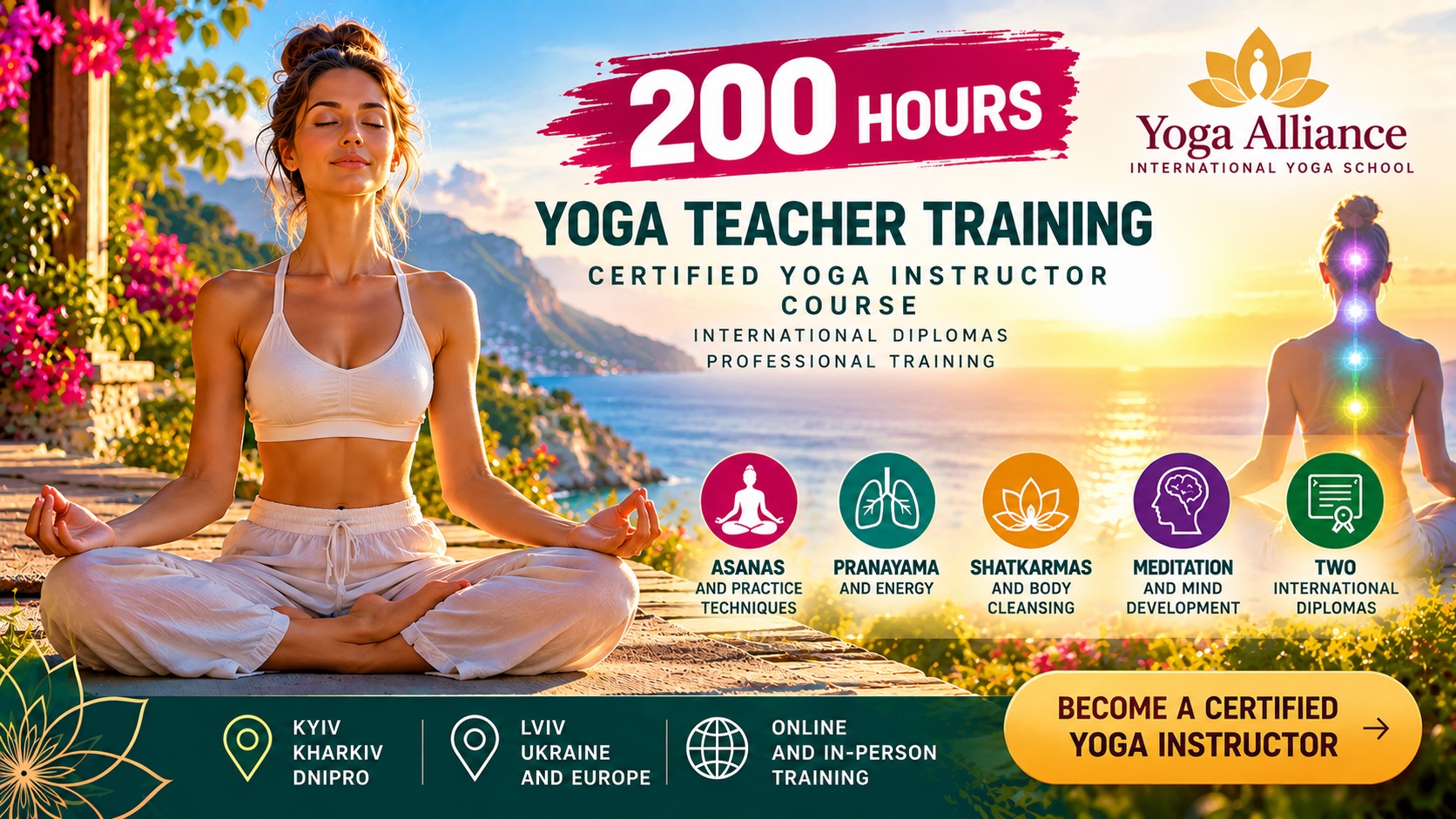
The Ukrainian Yoga Alliance is not simply about receiving a yoga instructor certificate. It is a system of professional teacher preparation: 200 hours of training, the study of techniques and comprehensive educational materials, practical experience conducting classes independently, certification, and continued professional development.
If your goal is not simply to complete a course but to genuinely learn how to teach yoga, choose an education that prepares you to meet your first students with confidence, professionalism, knowledge, and responsibility.
Teacher Training and Certification
The Ukrainian Yoga Alliance is the largest non-profit organization responsible for establishing and maintaining yoga teaching standards in Ukraine.
The main areas of activity of the Alliance include:
•uniting the professional yoga community;
•developing and approving qualification requirements;
•official certification of yoga instructors;
•maintaining the Unified Register of Certified Teachers.
The Ukrainian Yoga Alliance is the largest non-profit organization that establishes and maintains yoga teaching standards in Ukraine.
The main areas of activity of the Alliance include:
•uniting the professional yoga community,
•developing and approving qualification requirements,
•official certification of yoga instructors,
•maintaining the Unified Register of Certified Yoga Teachers.
Training Format and Examination
Within online yoga instructor training courses, students of the Yoga Alliance School undergo mandatory practical and theoretical assessment.
Passing Surya Namaskar is part of the examination process.
A video of the exam, conducted within online courses, is available via the link — click to watch.
You can watch a full video overview of the online course by the Head of the Yoga Alliance, Vladimir Bondarenko, on our YouTube channel by following the link.
Training Locations and Tuition Fees
Branches of the Yoga Alliance School have resumed operations in the following cities:
• Kyiv
• Kharkiv
• Dnipro
• Odesa
• Lviv
• Klaipėda (Lithuania)
• Bansko (Bulgaria)
• Athens (Greece)
• Prague (Czech Republic)
• Torrevieja (Spain)
• Vienna (Austria)
• Cascais (Portugal)
These branches offer continuously running offline yoga instructor training courses led by senior instructors of the Alliance.
Tuition fees:
•online course — 15,500 UAH
•offline course — 17,500 UAH
Since August 2022, instructors who successfully pass examinations with distinction receive the right to train future yoga instructors on behalf of the Yoga Alliance and conduct teacher training courses jointly with the Organization.
Such instructors receive the status of Senior Instructor of the Yoga Alliance and earn 50% of the course fee for each student.
For full details, contact us via Viber / Telegram / WhatsApp:
+380984777777
Training Results
After completing the one-month course and successfully passing the exams, you will:
•receive two international Yoga Alliance certificates registered with the Ministry of Justice of Ukraine;
•obtain the right to teach yoga in more than 100 countries worldwide;
•master a well-structured class format including kriyas, pranayama, and meditation;
•receive lifetime access to video lessons, an application for learning posture names, and 12 balanced printed lesson plans for the first year of teaching;
•receive the “Gold Standard” methodological guide — a detailed manual on asanas, chakras, mudras, bandhas, and key techniques of classical yoga.
Additional Materials
Contacts and Registration
You can read more about the Yoga Instructor Course on the course website:
Course registration:
📞 Phone: +380984777777
(Viber / Telegram / WhatsApp)
Yoga Alliance website: